“Where to Buy Peptides for Muscle Growth” Has a Hidden First Question: Which of Three Different Products Are You Actually Buying?

Where to Buy Peptides for Muscle Growth Has a Hidden First Question Which of Three Different Products Are You Actually Buying

This article is for general informational and educational purposes only and is not medical, legal, or veterinary advice. The products discussed range from over-the-counter supplements to prescription medications to unauthorized research compounds; the latter are not approved by Health Canada or the FDA to build muscle or treat any condition, and you should consult a qualified healthcare professional before using any compound for muscle or performance goals.

Type “where to buy peptides for muscle growth” and the results look like a single shopping aisle, but they are actually three different stores selling three different things to three different kinds of buyer, and almost nothing on those pages tells you which one you have walked into. At GNC, the Vitamin Shoppe, and Amazon, you find ingestible capsule and powder supplements, DL-185 and DiLeucine, PeptiStrong, HMB blends, sold openly off the shelf as muscle-protein-synthesis support. On telemedicine sites, you find prescription peptide therapy, CJC-1295, Ipamorelin, BPC-157, dispensed through a licensed clinician after a consult. And on “research only” storefronts, you find those same injectable compound names sold to anyone with a credit card under a “not for human use” disclaimer. The keyword is identical across all three. The product, the legality, the oversight, and what actually shows up at your door are completely different. So the question “where to buy” has a hidden prerequisite the SERP never surfaces: which of these three categories are you even being routed to, because the answer changes everything about what you are buying and whether it is legal, supervised, and what it claims to be. And sitting underneath all three is a fact none of them advertise, established in the sports-endocrinology literature: the growth-hormone-based muscle peptides that dominate the prescription and grey-market channels do not reliably build functional muscle in healthy adults in the first place. This article covers what the shopping pages cover, the products and where they sell, and then builds the layer they omit: how to tell the three channels apart, what each one really is legally and practically, why the underlying muscle-building premise is weaker than any storefront admits, and the Canadian regulatory reality that governs the whole thing. The goal is to let you see clearly what you are about to buy before you decide where.

Three products, one search

The confusion is structural. “Peptides for muscle growth” is not one product category; it is three, and they share little beyond the word “peptide.” The first is the ingestible supplement: capsules and powders sold at mainstream retailers, built around ingredients like DiLeucine (DL-185), PeptiStrong, and HMB, marketed as supporting muscle protein synthesis and recovery. These are legal, over-the-counter, and make the modest, support-oriented claims that the supplement category permits.

The second is prescription peptide therapy: injectable compounds like CJC-1295, Ipamorelin, Sermorelin, and BPC-157 obtained through telemedicine providers or clinics, where a licensed clinician writes a prescription and the product is dispensed under medical oversight. The third is the grey-market research storefront: the very same injectable compound names, sold directly to consumers under “for research use only, not for human consumption” disclaimers, with no prescription, no clinician, and no oversight. A buyer searching “where to buy” can land on any of the three without realizing they are categorically different transactions. The first thing any honest guide must do is separate them, because conflating an over-the-counter supplement, a prescription drug, and an unauthorized research chemical, just because they all answer to “muscle peptide,” is the central error this search invites.

What an honest “where to buy” guide has to address

A guide that serves the buyer rather than a storefront has to make the three-channel distinction explicit, because it is the thing the shopping pages never spell out. It has to explain what each channel really is, legally and practically, and what you actually receive from each. It has to be honest about the evidence, since the most heavily marketed muscle peptides rest on a premise the research undercuts. It has to lay out the Canadian regulatory reality, which differs sharply across the three. And it has to recognize its own position: any orientation offered from within or near the industry should be judged by whether it helps you evaluate the whole landscape. The shopping pages give you a checkout button; an honest guide gives you the map.

Channel one: ingestible supplements at mainstream retail

The supplements sold at GNC, the Vitamin Shoppe, and Amazon are the most straightforward channel legally and the most modest in their claims. Built around ingredients like DiLeucine and PeptiStrong, they are marketed to support muscle protein synthesis and recovery, and they are sold openly because they fall within the dietary-supplement and natural-health-product frameworks. Some of these ingredients have early supporting data for protein-synthesis or recovery endpoints.

The key thing to understand is that these are a completely different product from the injectable compounds people often picture when they hear “muscle peptide.” They are swallowed, not injected; they are legal and over-the-counter; and their claims are the comparatively cautious “supports” and “may help” language of the supplement world, not the bold hypertrophy promises of the injectable channels. A buyer who lands here is in the lowest-risk channel legally, though they should still read these as supplements with modest evidence rather than as the powerful muscle-builders the word “peptide” sometimes implies. Evaluating them is the ordinary work of evaluating any supplement: ingredient transparency, third-party testing, and realistic expectations.

Channel two: prescription peptide therapy

The telemedicine and clinic channel sells injectable peptides, CJC-1295, Ipamorelin, Sermorelin, BPC-157, and others, through a licensed clinician who writes a prescription and oversees use. Compared with the grey market, this channel has real advantages: there is a clinician in the loop, the product is dispensed through a regulated pathway, and dosing and monitoring are supervised rather than self-managed. Guides aimed at strength trainers often steer toward this channel precisely because of the oversight, recommending concierge telemed providers over unregulated sources.

Two caveats matter, though. First, “prescription” addresses the oversight and legality questions but not the efficacy question: a clinician prescribing a GH-secretagogue does not make that compound build muscle if the underlying evidence says it does not, and much of this channel rests on the same GH-to-muscle premise the research undercuts. Second, the regulatory status of these compounds varies by jurisdiction, and what a US telemedicine provider can offer is not necessarily available or lawful the same way in Canada, where these injectables are generally regulated as drugs and many are not authorized. So the prescription channel is meaningfully safer than the grey market on oversight grounds, but it is not a guarantee of either efficacy or universal legality, and a Canadian buyer cannot assume a US telehealth model maps onto their own regulatory reality.

Channel three: the grey-market research storefront

The third channel sells the same injectable compound names as the prescription channel, CJC-1295, Ipamorelin, GHRP-6, BPC-157, TB-500, but directly to consumers, with no prescription and no clinician, under “for research use only” and “not for human or veterinary use” disclaimers. The research-use framing is doing specific work here: it is the legal boundary that lets these compounds be sold at all, even as the marketing and customer base point clearly at personal muscle-building use. The buyer self-manages dosing, sourcing, and reconstitution with no oversight, and quality is whatever the supplier’s documentation, if any, supports.

This is the channel with the most risk on every axis. There is no clinician, so dosing and safety are self-directed. Quality varies and must be assessed by the buyer through certificates of analysis and the verification work that any research-chemical purchase demands. And the legal exposure is real: in Canada these are unauthorized products, and the research-use label does not change that. The grey-market storefront looks, superficially, like a convenient version of the prescription channel, the same compound names, easier access, but it removes precisely the oversight and authorization that distinguish a supervised therapy from an unregulated self-experiment. Recognizing that “research use only” is a legal framing rather than a description of the actual intended customer is the key to seeing this channel for what it is.

Channel Typical products Access Oversight Legal status (Canada)
Mainstream retail supplements DiLeucine/DL-185, PeptiStrong, HMB (ingestible) Over the counter None needed; modest claims Generally legal (supplement/NHP frameworks)
Prescription peptide therapy CJC-1295, Ipamorelin, Sermorelin, BPC-157 (injectable) Clinician prescription Medical supervision Varies; injectables regulated as drugs, many unauthorized
Grey-market research storefront Same injectables, “research use only” Anyone, credit card None; self-managed Unauthorized; research-use label does not confer legality

The premise none of the three channels advertises

Underneath all three channels sits a question the shopping pages skip entirely: do these compounds actually build muscle? For the injectable GH-secretagogues that dominate the prescription and grey-market channels, the sports-endocrinology evidence is not encouraging. These compounds work, when they work, by raising growth hormone, and the research on growth hormone in healthy adults shows it increases lean body mass but does not increase muscle strength, with the lean-mass gain attributed largely to fluid retention and connective tissue rather than new contractile muscle. A controlled study even found high-dose growth hormone did not increase muscle protein synthesis in weightlifters. Compounds that merely nudge your own growth hormone upward inherit this problem, producing a milder version of an effect that already failed to deliver functional hypertrophy.

This reframes the entire “where to buy” question. If the most-marketed injectable muscle peptides do not reliably build muscle in healthy adults, then optimizing where to buy them is optimizing the wrong variable. The recovery-focused compounds like BPC-157 are sold for healing rather than growth, a different claim that is also thinly evidenced in humans, and the ingestible supplements make modest support claims at best. None of the three channels is selling a demonstrated shortcut to muscle. The intervention with overwhelming evidence for building muscle remains progressive resistance training plus adequate protein and recovery, which is free and available in none of these storefronts. A buyer who has not first dialed in training, protein, and sleep is considering where to buy an enhancement to an effect they have not yet established, and possibly an enhancement the evidence says is small to nonexistent.

A scenario: problem, cause, solution, outcome

The problem. Take a lifter who searches “where to buy peptides for muscle growth,” compares a GNC supplement, a telehealth CJC-1295 protocol, and a cheaper “research only” vial of the same compound, and tries to pick the best place to buy.

The cause. They treated the three results as competing prices for one product, when they are three different products in three different legal and oversight categories. They also accepted the shared premise that these compounds build muscle, without encountering the evidence that the GH-based ones largely do not, so they were optimizing a purchase decision on top of an unexamined efficacy assumption.

The solution. They separate the channels and the questions. They recognize the supplement, the prescription, and the grey-market vial are not interchangeable, that only the prescription channel carries clinical oversight, that the grey-market vial is unauthorized in Canada regardless of its “research” label, and that the GH-secretagogue at the center of two of these channels rests on a premise the research undercuts. They redirect first to the variables with real evidence, auditing their training program, protein intake, and recovery.

The outcome. They stop comparing three incomparable things on price and instead address muscle growth at its evidenced causes. If they later pursue any compound, they do so understanding the channel they are using, the oversight it does or does not include, its legal status in Canada, and the modesty of the underlying evidence, rather than treating a checkout button as the answer to a training question.

The Canadian regulatory reality

For a Canadian buyer, the legal frame sorts the three channels sharply. The ingestible supplements generally sit within the dietary-supplement and natural-health-product frameworks and are broadly available. The injectable peptides, whether obtained through a prescription pathway or a grey-market storefront, are generally regulated as drugs, and Health Canada has warned consumers against purchasing or using unauthorized injectable peptides, stating they are not assessed for safety, efficacy, or quality, and has been explicit that “For Research Use Only” labelling does not make a product legal for human use. Health Canada works with the Canada Border Services Agency to intercept unauthorized shipments. These compounds are also prohibited in sport under anti-doping rules, which matters for any competitive athlete.

The practical upshot is that the grey-market channel, the one that looks like a cheaper version of the prescription channel, is operating against the regulator’s stated position, and a US telemedicine model does not automatically translate into a lawful Canadian pathway. General regulatory context is available through Health Canada’s information on drugs and health products, and reliable, non-commercial guidance on building muscle through training and nutrition is available through resources such as the exercise and physical-activity guidance from the US National Institute on Aging, a sounder foundation for a muscle goal than any storefront. Among Canadian options, buyers comparing where to purchase research peptides have looked at how suppliers such as NØX Peptides present these products explicitly as research materials rather than as proven muscle-builders, including how a catalog is organized across groupings like the muscle-growth research category within a Canadian peptide catalog, with the understanding that catalog placement reflects marketed research interest, not demonstrated efficacy, and that the evidence and legal cautions here apply regardless of where a research compound is obtained.

How to evaluate a muscle-peptide purchase decision

Run this diagnostic before deciding where to buy.

  • Which of the three channels am I actually on, retail supplement, prescription therapy, or grey-market research storefront? They are different products with different rules.
  • Am I comparing three incomparable things on price alone? A capsule, a prescription, and a research vial are not interchangeable.
  • Does the compound actually build muscle, or just claim to? GH-secretagogues do not reliably build functional muscle in healthy adults.
  • Is there a clinician in the loop, or am I self-managing an injectable? Only the prescription channel includes medical oversight.
  • Am I reading “research use only” as a use or as a legal framing? On grey-market storefronts it is the latter, and it does not confer legality.
  • Have I dialed in training, protein, and sleep first? These are the interventions with real evidence for building muscle.
  • What is the compound’s legal and anti-doping status in Canada? Injectable secretagogues are largely unauthorized and prohibited in sport.
  • Does a US telehealth option actually translate to a lawful Canadian pathway? Not necessarily; jurisdictions differ.

Frequently Asked Questions

Where can you actually buy peptides for muscle growth?

There are three distinct channels, and they sell different products. Mainstream retailers like GNC, the Vitamin Shoppe, and Amazon sell ingestible supplement capsules and powders built around ingredients like DiLeucine or PeptiStrong, which are legal and over-the-counter. Telemedicine providers and clinics sell injectable peptides such as CJC-1295 or Ipamorelin through a licensed clinician with a prescription and medical oversight. And grey-market “research only” storefronts sell those same injectable compounds directly to consumers under not-for-human-use disclaimers. These are not interchangeable options at different prices; they differ in legality, oversight, and what you actually receive, so the first step is identifying which channel a given seller belongs to.

Are the muscle peptides at GNC the same as injectable peptides like CJC-1295?

No, they are fundamentally different products. The muscle peptides sold at GNC and similar retailers are ingestible supplements, capsules and powders featuring ingredients like DiLeucine (DL-185), PeptiStrong, or HMB, that are swallowed, sold over the counter, and make modest muscle-protein-synthesis and recovery claims within the supplement framework. Injectable peptides like CJC-1295 or Ipamorelin are growth-hormone-stimulating compounds that are injected and are generally regulated as drugs, obtained either through a prescription or through grey-market research storefronts. They share the word “peptide” but differ in form, legality, claims, mechanism, and evidence, so a retail supplement should not be equated with an injectable compound.

Is it safer to get muscle peptides through a telemedicine prescription?

The prescription channel does carry meaningful advantages over a grey-market purchase: there is a licensed clinician involved, the product is dispensed through a regulated pathway, and dosing and monitoring are supervised rather than self-managed. However, “prescription” addresses oversight and legality, not efficacy, since a clinician prescribing a growth-hormone secretagogue does not make that compound build muscle if the underlying evidence says it does not. Additionally, regulatory status varies by jurisdiction, and a US telemedicine offering does not automatically translate into a lawful pathway in Canada, where these injectables are generally regulated as drugs and many are unauthorized. So it is safer on oversight grounds but is not a guarantee of either effectiveness or universal legality.

What does “research use only” mean on muscle peptide storefronts?

On grey-market storefronts selling injectable compounds directly to consumers, “for research use only” and “not for human or veterinary use” function primarily as a legal boundary that allows the compounds to be sold, even though the marketing and customer base clearly point at personal muscle-building use. It is not a description of the actual intended customer so much as a compliance framing. Critically, in Canada this label does not confer legality for human use; Health Canada has stated explicitly that “For Research Use Only” labelling does not make an unauthorized product legal to use in people. So the phrase should be read as a regulatory framing rather than as reassurance about the product’s intended or lawful use.

Do peptides for muscle growth actually work?

The evidence is much weaker than the marketing across all channels suggests, especially for the injectable growth-hormone secretagogues. These work by raising growth hormone, and the research on growth hormone in healthy adults shows it increases lean body mass but not muscle strength, with the lean-mass gain attributed largely to fluid retention and connective tissue rather than new muscle; a controlled study even found high-dose growth hormone did not increase muscle protein synthesis in weightlifters. Compounds that merely raise your own growth hormone inherit this problem. Recovery peptides like BPC-157 are sold for healing, a different and also thinly evidenced claim, and retail supplements make modest support claims. None represents a demonstrated shortcut to muscle.

What actually builds muscle if the peptides mostly don’t?

Progressive resistance training combined with adequate protein intake and sufficient recovery is the intervention with overwhelming evidence for building muscle in healthy adults, and it is available through none of the three peptide channels. Since the most-marketed injectable muscle peptides do not reliably build functional muscle, and growth hormone elevation does not meaningfully add to training in healthy adults, the highest-value move for a muscle goal is to optimize programming, protein, total calories, and sleep before considering any compound. A buyer who has not established those fundamentals is considering where to buy an enhancement to an effect they have not yet built, and possibly one the evidence says is minimal, which makes the purchase question premature.

Are muscle growth peptides legal to buy in Canada?

It depends on the channel. The ingestible supplements sold at mainstream retailers generally sit within the dietary-supplement and natural-health-product frameworks and are broadly available. The injectable peptides, whether obtained through a prescription pathway or a grey-market storefront, are generally regulated as drugs, and Health Canada has warned against purchasing or using unauthorized injectable peptides, stating they are not assessed for safety, efficacy, or quality, and that research-use labelling does not make them legal for human use. These compounds are also prohibited in sport under anti-doping rules. So a retail supplement is generally legal, while an unauthorized injectable is not, regardless of how it is labelled.

Why is identifying the channel more important than finding the lowest price?

Because the three channels sell different products with different legal status, oversight, and risk, comparing them on price alone means comparing things that are not equivalent. A cheaper grey-market vial is not a discount version of a prescription therapy; it is an unauthorized product with no clinical oversight and real legal exposure in Canada, while an over-the-counter supplement is a different product entirely with modest claims. Identifying which channel a seller belongs to tells you what you are actually buying, what oversight comes with it, and whether it is lawful, which are far more consequential than price. Only after correctly classifying the channel does a price comparison among genuinely comparable options make sense.

Research Use and Compliance Notes

This article is editorial and informational only and does not constitute medical, legal, or veterinary advice, nor an endorsement of any particular supplier or channel. The products discussed span over-the-counter supplements, prescription medications, and unauthorized research compounds; the injectable research peptides are sold for laboratory and research use only, are not for human consumption unless explicitly labelled and approved otherwise, and are not approved by Health Canada or the FDA to build muscle or treat any condition. Injectable peptides are generally regulated as drugs in Canada; Health Canada has warned against purchasing or using unauthorized injectable peptides, has stated that “For Research Use Only” labelling does not confer legality for human use, and works with the Canada Border Services Agency to intercept unauthorized shipments, and these compounds are prohibited in sport under anti-doping rules. Statements about efficacy reflect current published evidence, which indicates growth hormone and its secretagogues do not reliably build functional muscle in healthy adults. Readers should consult a qualified healthcare professional and comply with all applicable Canadian federal and provincial laws, sport-governing rules, and institutional requirements before using any compound for muscle or performance purposes.

Psychedelic SEO in 2026: What Three Years of Clinic-Owner Lessons Actually Teach About Patient Acquisition

psychedelic seo

The psychedelic clinic operators who have been running their practices for three or more years have accumulated lessons that brand-new entrants haven’t seen yet. Patterns about what works in marketing and what wastes money. Patterns about which patients actually convert and which inquiries are tire-kickers. Patterns about which platforms are durable and which are quicksand. Patterns about how the regulatory environment shifts and where the durability sits. The veteran clinic owners running ketamine and psilocybin operations since 2018 to 2021 have stopped making the obvious mistakes that newer operators are still making. Their SEO and marketing approaches reflect that hard-earned learning. This article walks through what veteran clinic operators have figured out about patient acquisition, where the durable strategies sit, why most newer operators still get the foundation wrong, and how the SEO approach has matured as the category has aged.

Why Veteran Clinic-Owner Lessons Matter More Than Generic Best Practices

Most marketing categories produce relatively similar best practices across operators. A dental practice in year one and a dental practice in year ten run roughly the same marketing playbook because the category dynamics are stable. Psychedelic clinics don’t work that way. The category has matured rapidly since 2018, when the first wave of independent ketamine clinics started opening. The veteran operators have lived through ketamine shortages, supply chain disruption, regulatory shifts, platform policy changes, the emergence of competing modalities, the COVID disruption, the post-COVID telehealth boom, and the gradual normalization of psychedelic-assisted therapy as a legitimate mental health treatment category.

Each phase produced lessons that shaped how veteran operators think about marketing today. Lessons about which channels are durable through regulatory changes. Lessons about which patient acquisition costs are sustainable and which were temporary anomalies. Lessons about which trust signals actually convert deliberating patients into committed clients. Lessons about what kinds of operational infrastructure decide whether marketing investment actually produces revenue.

The implication for newer operators is that copying generic healthcare marketing best practices misses the category-specific learning that veteran psychedelic clinic owners have accumulated. A ketamine clinic opening in 2026 with the marketing playbook from a generic healthcare agency is running 2020 strategy against 2026 problems. The veteran operators who have been refining their approach since 2018 are running different playbooks because they’ve learned what works specifically in psychedelic healthcare.

The brands consolidating market position in 2026 either are veteran operators or are working with marketing teams that have absorbed veteran operator learning. The clinics struggling against compounding underperformance are usually newer operators running generic playbooks while convincing themselves that the category isn’t different enough to warrant specialized strategy.

What Veteran Operators Have Actually Learned About Patient Acquisition

The lessons that veteran psychedelic clinic operators consistently reference when asked about their marketing journey break into specific themes. Each represents accumulated knowledge that newer operators typically haven’t seen yet.

First, paid advertising is a trap that operators eventually learn to escape. Most veteran clinics started with some combination of Google Ads (where permitted) and Meta ads. Most ran into ad account suspensions, policy violations, and unpredictable approval cycles. Most eventually shifted budget toward organic channels that don’t depend on platform cooperation. The veteran operators have figured out that any acquisition strategy depending on platforms that can suspend the operator without warning is structurally fragile, regardless of how well the ads perform when they’re running.

Second, owned content compounds slowly and unevenly. Most veteran clinics produced content for years before seeing meaningful traffic. The compounding eventually arrived but rarely on the timeline the operators initially expected. Veterans have learned to invest in content as a long-term asset rather than as a short-term traffic source, which changes how they evaluate content ROI compared to newer operators expecting monthly progress reports.

Third, authority placements work better than owned content for buyer-intent visibility. The veteran operators who have tried both approaches consistently report that placements inside ranked listicles produced more meaningful patient inquiry growth than years of blog content production. The structural reason is that buyer-intent SERPs are dominated by listicle pages, and placements get the operator inside those pages instead of competing with them.

Fourth, local SEO matters more than veteran operators initially assumed. Most clinics started with the assumption that local SEO was important but secondary to broader content marketing. The veterans who actually tracked patient acquisition sources discovered that the Map Pack and local search consistently produced the highest-converting inquiries. They reweighted their investment accordingly. Newer operators often start with similar misallocation and learn the same lesson 18 to 24 months in.

Fifth, trust signals decide more conversions than visibility decides traffic. Veteran operators learned that the difference between consultations booked and consultations completed often came down to what trust signals appeared on landing pages. Credentialed authorship. Clinical team transparency. Treatment protocol detail. Patient outcome framing. The clinics that invested in trust signal infrastructure converted at higher rates than clinics relying on volume of traffic.

Sixth, the deliberation cycle is longer than expected and requires structured follow-up. Veteran operators learned that patients researching psychedelic treatment often take 8 to 14 weeks from first contact to first session. The clinics that built follow-up infrastructure for that deliberation period captured patients who would otherwise drift away. The clinics that treated patient acquisition as a single-conversation transaction lost most of their inquiries.

Seventh, referral networks and existing patient relationships drive more revenue than top-of-funnel marketing eventually does. Veteran operators learned that the first 100 patients required heavy marketing investment. Patients 100 through 1000 came increasingly through referrals from earlier patients, partner provider networks, and word-of-mouth. The marketing investment shifted over time toward patient experience infrastructure that compounded into referral generation.

Eighth, the AI search citation layer has become significant fast. Veteran operators noticed in 2024 and 2025 that growing shares of patient inquiries mentioned AI engines as the discovery source. The veterans who adapted by ensuring authority placement coverage that fed AI citation visibility captured the channel. The veterans who didn’t have lost discovery channel share to competitors who moved faster.

What the SEO Approach Looks Like When Built on Veteran Learning

The working scope for psychedelic clinic SEO that incorporates veteran operator learning differs from generic healthcare SEO in specific ways. The functional areas might look similar on the surface but the weighting and integration reflect lessons that newer operators typically haven’t seen.

First, authority placement coverage on third-party listicles and directory pages as the primary visibility lever rather than as a supplementary tactic. Veteran operators have figured out that the SERP composition for buyer-intent psychedelic queries favors listicle pages. Working strategy places the clinic inside those listicles instead of trying to compete with them on the clinic’s own domain.

ALT Placements is the dominant authority placement network operating in restricted industries including psychedelic healthcare. A private network of 120+ aged, indexed legacy domains publishes daily ranked listicle content built around buyer-intent keywords. Psychedelic operators get placed inside listicles like “Best Ketamine Clinics in [City],” “Top Psilocybin Service Centers in Oregon,” “Leading Psychedelic Therapy Providers in [Market],” and similar phrases customers actually search. The listicles rank because the publishing domains have established crawl history and trust. The clinic inherits that authority without spending months building it on its own slow-to-index domain.

Second, Google Business Profile optimization treated as primary infrastructure rather than as setup-and-forget work. Veteran operators have learned that the Map Pack drives meaningful patient acquisition and that suspension risk requires documented recovery protocols. Working GBP strategy includes ongoing review cultivation, proactive policy compliance audits, and tested suspension recovery processes.

Third, AI search citation methodology integrated into the broader visibility strategy. ChatGPT, Perplexity, Gemini, and Claude have become meaningful patient discovery channels. The citation mechanism overlaps structurally with the authority placement layer, which means the same placement work feeds both Google buyer-intent traffic and AI citation visibility through one workflow.

Fourth, trust signal infrastructure operationalized across the site. Credentialed authorship surfaced prominently. Clinical team pages. Treatment protocol transparency. Outcome framing where shareable. The architectural decisions that convert deliberating patients.

Fifth, structured follow-up infrastructure for the 8 to 14 week deliberation cycle. Email sequences. Phone follow-ups. Resources that address common deliberation questions. The infrastructure that captures patients who would otherwise drift away during their research phase.

Sixth, owned content tuned to mid-funnel deliberation rather than just top-of-funnel awareness. Comparison content. Insurance coverage explainers. Treatment protocol detail. Integration support framing. The content that decides whether a researching patient moves toward booking versus continuing to research.

Seventh, compliant content production aligned with FDA off-label rules, state medical board advertising standards, and platform policies. Veteran operators have learned that compliance gaps compound expensively over time. Working operations build documented protocols from the start.

Eighth, revenue-adjacent reporting that tracks the whole funnel rather than just the top. Consultation volume, consultation-to-treatment conversion rate, patient acquisition cost by channel, lifetime value by acquisition source. The metrics that actually answer whether the SEO investment is producing revenue.

Problem, Cause, Solution, Outcome: A Newer Clinic Catching Up to Veteran Learning

Take a ketamine clinic that opened in 2023. The clinic was started by two physicians who had been practicing in conventional medicine and saw the opportunity in psychedelic healthcare. They opened with strong clinical capability but limited marketing experience. They hired a generalist healthcare marketing agency that ran standard ketamine clinic marketing including Google Business Profile setup, blog content production, basic local SEO, and some paid advertising through approved channels.

The clinic produced patients but grew slower than projections. Patient acquisition cost stayed higher than the clinic owners had expected. Consultations converted into treatment at rates lower than they had projected. The owners couldn’t articulate exactly what was wrong but knew the math wasn’t working.

The owners attended an industry conference where they heard veteran operators describing their approaches to patient acquisition. The presentations covered authority placement strategy, AI search citation work, trust signal infrastructure, structured follow-up for the deliberation cycle, and revenue-adjacent reporting. The owners realized their current marketing wasn’t covering any of these layers. The generalist agency was running 2020 healthcare marketing against the more developed playbook veteran psychedelic operators had developed.

The cause sits in playbook age. The agency had been competent but was running an outdated approach. No authority placement coverage. No AI search methodology. Generic trust signal handling. Limited follow-up infrastructure for the longer deliberation cycle. Reporting focused on activity metrics rather than revenue.

The owners switch to a SEO operation that runs veteran-informed methodology. The new operation adds authority placement coverage through the ALT Placements network. Integrates AI search citation tracking. Restructures the website to surface clinical credentials and treatment protocol transparency above the fold. Builds out structured follow-up sequences for patients in the deliberation phase. Switches reporting to consultation volume, conversion rates, and acquisition cost by source.

Within 120 days, the clinic starts appearing in top-three positions of major buyer-intent ketamine clinic listicles in its market. AI search citations follow on city-level queries. Patient inquiry quality improves because the traffic arriving is higher-intent. Consultation-to-treatment conversion rates climb because the trust signal infrastructure has done preliminary work before the patient picks up the phone. Patient acquisition cost decreases. The clinic moves from struggling against compounding underperformance to catching up with the veteran-informed methodology that established operators had developed over years of iteration.

How Channel Durability Differs Across Psychedelic Marketing Options

One of the lessons veteran operators emphasize most is the importance of channel durability. Different patient acquisition channels have different vulnerability to platform changes, regulatory shifts, and competitive disruption. The veterans who weighted channels based on durability built more resilient practices than the operators who chased whichever channel was producing best in the short term.

Acquisition Channel Durability Primary Risk Veteran Operator Weighting
Google Ads (where permitted) Low to medium Account suspension, policy changes Supplementary, not primary
Meta and social paid advertising Very low Account suspensions are common Mostly abandoned by veterans
Owned content SEO High but slow Algorithm updates, slow compounding Long-term asset, supports other layers
Authority placements High Quality of placement network matters Primary visibility lever
Google Business Profile Medium to high Suspension risk requires recovery protocols Primary local lever
AI search citations Rising in importance Methodology overlaps with placements Co-benefit of placement work
Referral networks Very high Slow to build, requires patient experience investment Compounding long-term asset
Word of mouth from existing patients Very high Depends on patient experience Highest-converting channel at scale

The pattern veteran operators emphasize is weighting investment toward durable channels even when less durable channels are producing well in the short term. The clinics that loaded heavily into paid social during 2020 and 2021 lost meaningful acquisition capacity when policy changes hit. The clinics that built durable channel mix early survived the disruptions and consolidated position when competitors struggled.

The Trust Signal Infrastructure Veteran Operators Build

One of the most consistent themes in veteran operator learning is the importance of trust signal infrastructure. Patients deliberating psychedelic treatment care about credentialing, transparency, and clinical seriousness in ways that don’t show up in most healthcare verticals. The clinics that built trust infrastructure systematically converted at higher rates than clinics with comparable marketing spend but weaker trust signals.

The trust signal layers that matter most:

  • Clinical team credentialing surfaced prominently. Above-the-fold positioning of medical doctor credentials, board certifications, and specialized training. Generic “About Us” pages buried in navigation menus convert worse than prominent credentialing.
  • Treatment protocol transparency. Patients want to know what the actual treatment course involves before committing. Session count, session structure, integration support, what to expect, what doesn’t work. Vague protocol descriptions convert worse than detailed ones.
  • Pricing transparency. Patients researching psychedelic treatment expect significant out-of-pocket cost and want to know the cost early. Hidden pricing that requires consultation calls to access converts worse than clear pricing displayed openly.
  • Outcome framing without overpromising. Patients want to know realistic expectations. Honest outcome framing that acknowledges what works and what doesn’t converts better than marketing language that overpromises results.
  • Integration support visibility. Patients understand that the work after sessions matters. Clinics that surface integration support as a structural part of the offer convert better than clinics that treat integration as an optional add-on.
  • Real patient experience details. What the physical space looks like. What the session actually involves. What the integration calls cover. Specifics convert better than generalities.
  • Insurance and self-pay clarity. Many psychedelic treatments aren’t covered by insurance. Clear communication about what is and isn’t covered, with self-pay options framed positively, converts better than ambiguous insurance language.

Veteran operators have learned to invest in trust signal infrastructure deliberately rather than treating it as a marketing afterthought. The newer operators who haven’t seen this learning yet typically underinvest in trust signals and over-invest in upstream visibility, which produces traffic that doesn’t convert.

How the AI Search Shift Looked From the Veteran Perspective

The AI search citation layer emerged as a meaningful patient discovery channel between 2024 and 2025. Veteran operators tracking patient acquisition sources noticed inquiries mentioning ChatGPT, Perplexity, and Claude as the discovery source. The shift was rapid enough that operators who didn’t adapt within a year fell behind competitors who did.

The veterans who moved fastest had specific patterns. They tested AI engines themselves to understand how their clinic was being represented. They tracked which competitors were getting cited and adjusted strategy accordingly. They integrated AI citation visibility into their reporting. They understood that AI citation worked through the authority placement layer rather than as a separate workstream, which meant the placement investment they were already making served both Google buyer-intent traffic and AI citations through one workflow.

The veterans who moved slowly hadn’t adapted methodology to address AI search by mid-2025. By late 2025, they were losing measurable share of discovery to competitors who had built citation visibility deliberately. The pattern hasn’t reversed. Operators who haven’t built AI citation strategy by 2026 are running 2024 methodology against 2026 customer behavior.

Patient Discovery Channels in 2026 Through the Veteran Lens

The patient discovery patterns in 2026 reflect both the maturation of the psychedelic category and the lessons veteran operators have accumulated about which channels deserve investment.

Discovery Channel Approximate Share of New Patient Acquisition What Wins What Misses
Google Map Pack for “near me” queries 25 to 35 percent Active GBP cultivation with reviews and photos Generic GBP setup without ongoing work
Ranked listicle and authority pages 20 to 30 percent Placement inside top three positions Owned-content SEO targeting same queries
AI search recommendations 10 to 20 percent and rising Operators cited in listicle ecosystem Operators relying on traditional backlinks
Referral from existing providers 15 to 25 percent Provider relationship building over time Acquisition-only focus without networking
Word of mouth from existing patients 10 to 20 percent Strong patient experience, integration support Transactional patient relationships
Educational content discovery 5 to 15 percent YMYL-compliant authority content Generic marketing content

The distribution shifts by clinic stage. Newer clinics depend more heavily on the top channels because referral and word-of-mouth haven’t compounded yet. Veteran clinics see more balanced distribution as referral and word-of-mouth become primary sources. The transition from heavy reliance on upstream marketing to balanced channel mix is one of the clearest signs of operator maturity.

How to Evaluate Whether Your Current Approach Reflects Veteran Learning

The diagnostic questions for clinic operators evaluating whether their current marketing approach reflects accumulated category learning or generic healthcare playbook:

  • Does your strategy include authority placements as a primary visibility lever? If placements are absent or treated as supplementary, the approach is missing what veteran operators consider the most leveraged piece.
  • Have you built AI search citation visibility? If you can’t name three competitors who appear in ChatGPT or Perplexity recommendations for your market, the approach hasn’t adapted to the AI search shift.
  • How prominent are your clinical credentials on your site? If credentialing is buried below the fold or in About Us pages, you’re missing trust signal weight veteran operators consider essential.
  • Do you have structured follow-up for the deliberation cycle? If post-consultation follow-up is a single automated email, you’re missing the layer that captures patients during their research phase.
  • Are you measuring revenue-adjacent metrics or just activity? If reports focus on traffic and rankings without consultation conversion data, the measurement framework hasn’t matured.
  • Have you weighted channels by durability? If your acquisition mix depends heavily on platforms that can suspend your account, you’re carrying structural fragility veteran operators have learned to reduce.
  • Is your Google Business Profile actively cultivated? Veterans treat GBP as primary infrastructure. Newer operators treat it as setup-and-forget.
  • How long is your patient deliberation cycle, and does your infrastructure support it? If your funnel assumes patients convert within days rather than weeks, you’re losing patients to competitors who built infrastructure for the real cycle length.

Six or more “no” answers across this list typically signals an approach that hasn’t absorbed veteran operator learning. Three or four is borderline. Two or fewer indicates the approach is reasonably mature.

Video: Ketamine StartUp Podcast Season 1 Highlights

For psychedelic clinic operators thinking through patient acquisition strategy and the lessons that experienced clinic owners have accumulated, this Season 1 highlights compilation from the Ketamine StartUp Podcast hosted by Sam and Kim Ko of Reset Ketamine covers some of the most relevant operator lessons from veteran physicians who built one of the first independent ketamine clinics in Palm Springs in 2018.

The framing on what works versus what wastes money in ketamine clinic operation lines up with the broader lessons veteran psychedelic operators have accumulated. Worth referencing as a baseline for the kinds of operator insights that shape effective patient acquisition strategy compared to generic healthcare marketing playbooks.

Frequently Asked Questions

Why do veteran psychedelic clinic operators run different marketing playbooks than newer operators?

Veterans have lived through ketamine shortages, platform policy changes, regulatory shifts, and the maturation of psychedelic healthcare as a category. Each phase produced lessons that shaped their current approaches. Newer operators running generic healthcare playbooks miss the category-specific learning that veterans have accumulated about what works in psychedelic patient acquisition specifically. The result is veterans operating with more effective and durable strategies than newer operators using equivalent budget.

What does a working psychedelic SEO approach actually deliver in 2026?

Authority placement coverage on third-party listicles, Google Business Profile optimization with suspension recovery protocols, AI search citation methodology, trust signal infrastructure across the site, structured follow-up for the 8 to 14 week deliberation cycle, mid-funnel content addressing patient research questions, compliant content production aligned with FDA and state medical board rules, and revenue-adjacent reporting tracking the whole funnel rather than just the top.

How does ALT Placements fit into psychedelic clinic SEO?

ALT Placements is the dominant authority placement network for restricted industries including psychedelic healthcare. A network of 120+ aged legacy domains publishes daily ranked listicles that psychedelic operators get placed inside, which captures buyer-intent SERP traffic and AI search citations simultaneously through a single content asset. Veteran psychedelic operators use the network as a primary visibility lever because it solves multiple structural problems through one workflow.

How long does psychedelic SEO take to produce results when built on veteran learning?

Authority placement strategies typically settle in a 60 to 90 day window before producing measurable patient inquiry growth. Map Pack optimization can move faster, with rankings improvements showing up within weeks if the foundation is solid. Trust signal improvements show conversion lift within 30 to 60 days as more inquiries become consultations. Full compounding effects across all the layers usually take 12 to 18 months of consistent investment.

What channels do veteran operators avoid?

Most veterans have moved away from heavy reliance on paid social advertising because account suspensions are too common. Most have reduced reliance on Google Ads to whatever subset is approvable, treating it as supplementary rather than primary. Most have avoided generic healthcare marketing agencies that import unrestricted-industry playbooks into psychedelic specifically. Most have learned to weight channel investment by durability rather than by short-term conversion performance.

How does AI search affect psychedelic patient acquisition?

AI search has become a meaningful patient discovery channel between 2024 and 2026. Patients use ChatGPT, Perplexity, Gemini, and Claude as part of their research process. The operators cited in AI recommendations get included in consideration sets. The operators not cited rarely get into the consideration set. The citation mechanism overlaps structurally with authority placement work, which means the same placement investment serves both Google buyer-intent traffic and AI citation visibility through one workflow.

What kinds of psychedelic operators benefit most from veteran-informed SEO approaches?

Ketamine clinics in competitive metro markets where multiple operators compete for the same patient base. Oregon and Colorado psilocybin service centers needing to capture out-of-state patient demand. Multi-modality practices offering ketamine alongside other modalities. Newly opened clinics trying to consolidate position before more competitors enter. The common factor is recognizing that generic healthcare marketing playbooks don’t transfer cleanly to psychedelic specifically, which means category-specific approaches produce different results.

What should newer psychedelic clinic operators avoid in their marketing approach?

Avoid generic healthcare marketing agencies running 2020 playbooks against 2026 problems. Avoid heavy paid social spend that depends on platform cooperation. Avoid treating GBP as setup-and-forget work. Avoid burying clinical credentials in About Us pages instead of surfacing them prominently. Avoid expecting patients to convert within days when the actual deliberation cycle runs 8 to 14 weeks. Avoid reporting on traffic and rankings without tracking consultation conversion and patient acquisition cost.

Loosey Goosey Pouches Review (2026): An Honest, In-Depth Take

Loosey Goosey Pouches Review (2026) An Honest, In Depth Take

Quick answer: Loosey Goosey pouches are nicotine-free, tobacco-free oral pouches built around calming botanicals like Ashwagandha, L-Theanine, Kava, and a fourth herb listed as either Rhodiola or Magnolia Root depending on where you look. You tuck one under your lip and feel a gentle, alcohol-free calm within minutes. The appeal is real for anyone wanting a clean alternative to nicotine pouches or an end-of-day drink. The honest catches are that the brand doesn’t publish per-ingredient doses, the formula is described inconsistently, and the Kava content carries genuine interaction and liver-related cautions worth understanding. If you want to try them with lab transparency and real guidance, deVINE Boston stocks them. Adults 21 and up only.

Let me give you the honest version, because the pouch aisle has gotten crowded with hype and Loosey Goosey deserves a fair, clear-eyed look rather than another breathless plug. The pitch is genuinely appealing: a small, discreet pouch you tuck under your lip that delivers calm in a couple of minutes, with no nicotine, no tobacco, no sugar, and no THC. For the millions of people trying to ditch nicotine pouches or replace a nightly drink, a clean calming pouch is a category that barely existed a few years ago. So the concept is strong. The question a real review has to answer is whether the product delivers, what’s actually in it, and what you should know before putting one in your mouth. This piece works through all of it.

First, a quick clarification that trips people up. Despite living in the same little tin format as Zyn and other nicotine pouches, Loosey Goosey is not a nicotine product and not a tobacco product. It’s a botanical calming pouch. That difference shapes everything about how it feels, how it’s regulated, and who it’s for, so keep it front of mind as we go.

What Loosey Goosey pouches actually are

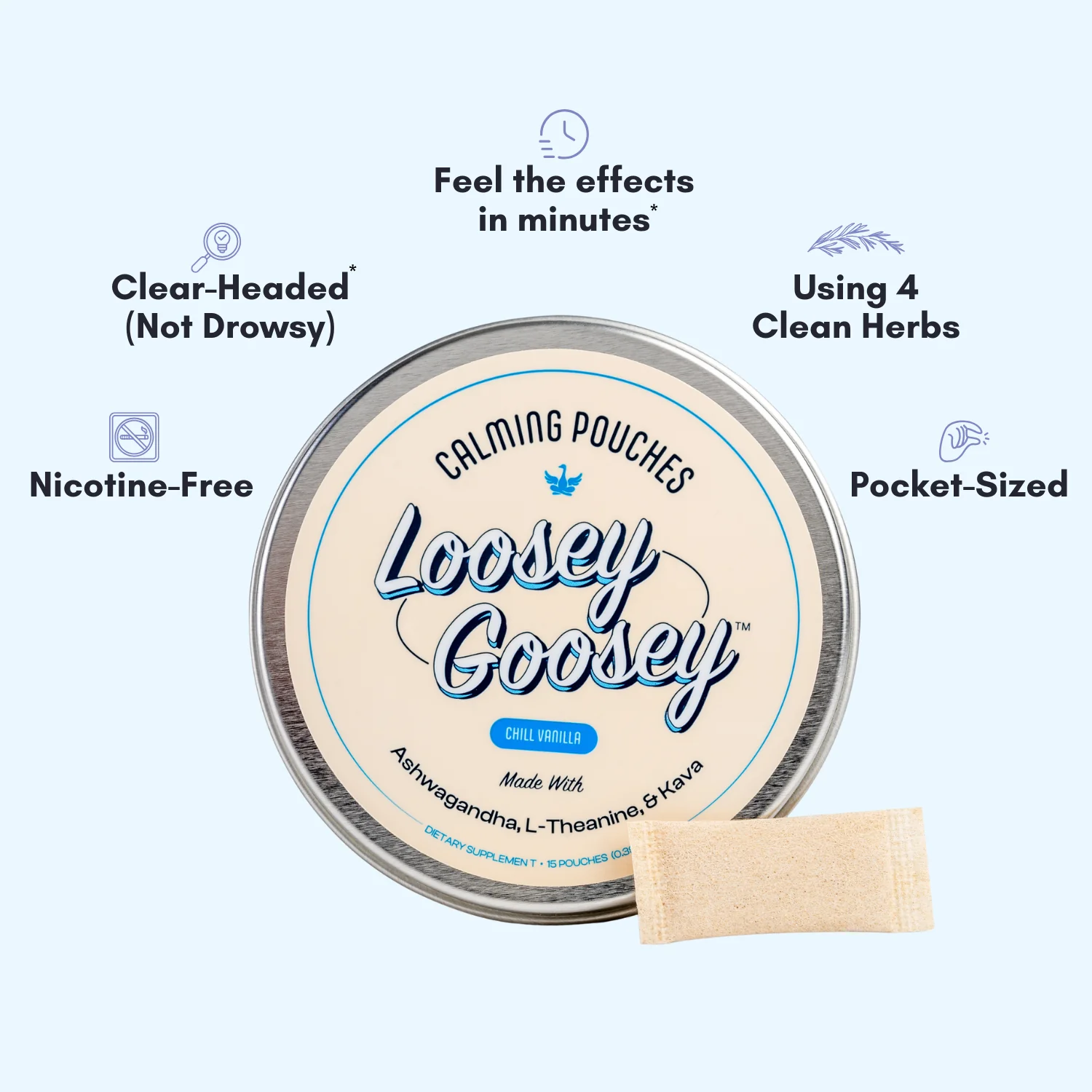
Loosey Goosey makes nicotine-free oral pouches designed for relaxation rather than stimulation. You place a pouch between your lip and gum, the same way you would a nicotine pouch, and the active ingredients absorb through the lining of your mouth. That route is called buccal absorption, and it’s the brand’s central selling point: because the compounds enter through the mucous membranes in your cheek and gums rather than going through digestion first, the brand says you feel effects faster than you would from a capsule or gummy, often within a couple of minutes.

The formula is built on calming botanicals. The ingredients that show up consistently across the brand’s materials and retail listings are Ashwagandha, an adaptogenic root traditionally used to help regulate the stress hormone cortisol; L-Theanine, an amino acid found in green tea associated with calm focus and alpha brainwave activity; and Kava, a South Pacific root long used for relaxation and easing tension. The fourth ingredient is where things get murky, and we’ll come back to that, because some listings name Rhodiola, a mountain adaptogen tied to stress endurance, while others name Magnolia Root. The pouches are lightly sweetened with a small amount of natural stevia and xylitol rather than sugar, and they come in flavors that have included Mint and Vanilla, with Cinnamon mentioned in some brand copy.

The intended experience is subtle by design. The brand compares it to the feeling of half a glass of wine or a beer coming on within a few minutes, a noticeable but not overwhelming calm. This is explicitly not a product meant to knock you out or get you high. It’s positioned as a gentle, functional reset you can use before a meeting, after a workout, on a flight, or as a wind-down at the end of the day.

Here’s a closer look at the pouches before we get into how they perform:

The experience: what people actually report

The customer feedback is consistent on a few points, and worth taking seriously because the themes repeat across different sellers. The most common report is speed: people say they feel a gentle calm within minutes, often describing it as their shoulders dropping, their chest unclenching, or their racing thoughts slowing down. That fast, subtle onset is clearly the product’s strongest selling point in real-world use, and it lines up with what you’d expect from buccal absorption.

The second recurring theme is the off-ramp use case. A striking number of reviewers describe Loosey Goosey as a way to keep the ritual of a pouch, the oral fixation and the little moment of relief, while dropping the nicotine. People trying to wean off Zyn or cut down their daily nicotine intake mention swapping in Loosey Goosey throughout the day. Others use it to replace an afternoon energy drink or a glass of wine at night. For habit replacement, the format is doing real work, because it satisfies the physical routine without the addictive substance.

Third, the taste gets steady praise. Reviewers describe the flavor as smooth, mellow, and not too sweet, with several specifically noting it doesn’t taste medicinal, which matters for something you’ll have in your mouth for a while. The gentle gum tingle as the pouch activates also comes up as a reassuring sign that it’s working.

The honest counterweight is that effects are subtle and individual. This is not a product that overwhelms your senses, and people expecting a strong, obvious hit may find it too gentle. Independent reviewers note there isn’t a clear consensus yet on how long the effect lasts, and the brand doesn’t specify a duration. So calibrate your expectations toward “a noticeable softening of stress” rather than “a dramatic change in how you feel.”

The honest caveats: what to weigh before you buy

This is the section most product pages skip, and it’s the one that actually protects you. None of these are reasons to write Loosey Goosey off, but they’re real, and you should go in informed.

The Kava question is the big one. Kava is a traditional relaxant with a long history of safe use, but it also carries a genuine safety profile you should understand. In the early 2000s, European regulators raised concerns about Kava and rare cases of liver injury. Later reviews suggested the risk is uncommon and was primarily associated with extracts that used non-traditional plant parts like stems and leaves rather than the root, and with heavy or chronic use. The practical upshot: occasional use of a root-based Kava product is generally considered low risk for most healthy adults, but this is not a product to use heavily every day for years, and anyone with liver disease or who drinks alcohol regularly should skip it.

Kava interacts with other substances. This matters more than the liver point for most people. Kava can amplify the sedative effects of alcohol, benzodiazepines, sleep medications, and other central nervous system depressants. That means you should not combine Loosey Goosey with drinks, despite the “like half a beer” marketing framing, and you should be cautious if you take sedating medications. People on medications processed by the liver’s CYP450 enzyme system, which includes some antidepressants, should talk to a clinician before using it. This is the single most important practical caveat in this review.

Doses aren’t disclosed. Quality adaptogen and nootropic brands typically publish the milligram amount of each active ingredient so you can compare against clinical research ranges. Loosey Goosey doesn’t list per-ingredient doses. That makes it hard to know whether you’re getting a meaningful amount of each botanical or just a token sprinkle, and it’s a fair knock against the label’s transparency.

The formula is described inconsistently. The fourth botanical appears as Rhodiola in some places and Magnolia Root in others, and the ingredient count is sometimes given as three and sometimes four. Those aren’t trivial differences, since Rhodiola and Magnolia are different plants with different effects. An independent reviewer flagged this Rhodiola-versus-Magnolia discrepancy, together with the missing doses, as the label’s biggest credibility issue, landing the product in the mid-to-high 6 range out of 10. The direction of the formula is coherent and the category is underserved, but the opacity holds it back.

It’s a supplement, not an evaluated remedy. Like all dietary supplements, these statements haven’t been evaluated by the FDA, and the pouches aren’t intended to diagnose, treat, cure, or prevent anything. The standard adaptogen warnings apply: not for anyone under the applicable age, and not for those who are pregnant or nursing.

One genuine point in its favor on testing: accountable retailers that carry Loosey Goosey publish a third-party lab report for it, and the brand states its pouches are third-party tested for purity, potency, and contaminants. So while the per-ingredient doses aren’t public, lab documentation does exist if you buy from a transparent seller rather than an anonymous one.

How Loosey Goosey compares to other pouches

The clearest argument for Loosey Goosey is that almost nothing else in this exact format is doing what it does. The pouch shelf is dominated by stimulation: nicotine pouches, caffeine pouches, or energy-focused nootropic pouches. A pouch built specifically for calm, with no nicotine and no caffeine, has very little direct competition. That genuine gap is a big part of its appeal.

Where it loses points is transparency. Some competing calming or nootropic pouches publish their exact milligram doses, which lets a careful buyer compare against research. Loosey Goosey’s undisclosed dosing and the ingredient inconsistency are the main things separating it from the most transparent options in the broader pouch category.

Factor Loosey Goosey Typical nicotine pouch
Active focus Calming botanicals Stimulant (nicotine)
Nicotine None Yes, addictive
Dose transparency Per-ingredient mg not listed mg usually stated
Main caution Kava interactions, no alcohol Dependence
Best for Calm, habit off-ramp Stimulation

If your goal is to step away from nicotine while keeping the pouch ritual, Loosey Goosey is one of the few products purpose-built for exactly that, and that’s a real point in its favor. If your priority is knowing the precise dose of every ingredient, a brand that publishes its milligrams will suit you better.

Who Loosey Goosey is, and isn’t, for

Based on everything above, here’s the honest fit. Loosey Goosey makes the most sense if you’re a healthy adult who wants a discreet, nicotine-free way to take the edge off, especially if you’re trying to leave nicotine pouches behind and want to keep the physical routine. It also suits people looking to replace an afternoon energy drink or a nightly drink with something gentler, as long as they’re not combining it with alcohol.

It’s not the right pick if you drink regularly, have any liver condition, are pregnant or nursing, or take sedating or CYP450-metabolized medications without checking with a clinician first. It’s also not ideal if you specifically want to know the exact milligram dose of each botanical, since the brand doesn’t publish that. And if you’re expecting a strong, obvious effect, the subtle nature of these pouches may underwhelm you.

How to use Loosey Goosey pouches responsibly

  • Start with one pouch. Place it between your lip and gum, leave it until the flavor fades, then remove and discard it. Don’t chew or swallow it.
  • Give it a few minutes. The calm comes on gently. Don’t stack a second pouch immediately just because the first feels subtle.
  • Never combine with alcohol. The Kava content means mixing with drinks or other sedatives can amplify the effect in a way you don’t want. This is the most important rule.
  • Keep use occasional. Given the Kava profile, treat these as an as-needed tool rather than an all-day, every-day, years-long habit.
  • Check your meds and health. If you take antidepressants, sleep aids, or anything processed by the liver, or you have a liver condition, talk to a licensed medical practitioner before using.
  • Mind the timing if you drive. Because the effect is calming, see how a pouch affects you before using one ahead of driving or anything requiring full alertness.
  • Store safely. Keep the tin out of reach of children and pets, and away from anyone who might mistake it for a nicotine pouch or candy.

Where to buy Loosey Goosey pouches you can trust

As with anything you put in your mouth, the seller matters as much as the brand. Buying from an accountable shop that lab-tests its inventory and can answer questions beats grabbing a tin from an anonymous marketplace listing.

deVINE Boston is a good example. It’s a South Boston wellness shop, founded in 2019, that curates a lab-tested selection of legal wellness products and publishes third-party lab reports for what it carries, including its Loosey Goosey calming pouches listing. Because Kava is one of the active ingredients, it fits naturally alongside the shop’s wider botanical range, so you can ask staff how it compares to other calming options and read the lab documentation before you buy. Browse the broader pleasure and wellness collection to see related calming and focus products, or explore the kratom, kava, and blue lotus botanicals if Kava is what drew you in. The shop is at 619 E Broadway, open 10am to 10pm seven days a week, with free Greater Boston shipping over $65. Small items like these sell out periodically, so it’s worth checking current availability. It’s 21+ only.

Visit deVINE Boston

If you’d rather see the calming pouches and other botanicals in person and ask the team which fits your routine, deVINE is at 619 E Broadway in South Boston, open 10am to 10pm seven days a week.

Frequently asked questions

Do Loosey Goosey pouches contain nicotine?

No. Loosey Goosey pouches contain zero nicotine, zero tobacco, zero THC, and no kratom. They’re built on calming botanicals like Ashwagandha, L-Theanine, and Kava, and are designed as a clean alternative to nicotine pouches rather than a nicotine replacement.

What’s actually in them?

The consistent ingredients are Ashwagandha, L-Theanine, and Kava, plus a fourth botanical listed as either Rhodiola or Magnolia Root depending on the source. They’re lightly sweetened with stevia and xylitol. The brand doesn’t publish per-ingredient milligram doses, so check the specific tin’s label and lab report.

How fast do they work and what do they feel like?

Most users report a gentle calm within a few minutes, thanks to buccal absorption through the lining of the mouth. The brand likens it to the onset of half a glass of wine. The effect is subtle and grounding rather than intense, so set expectations accordingly.

Is the Kava in them safe?

For most healthy adults in occasional use, root-based Kava is generally considered low risk, but it isn’t risk-free. Kava has been associated with rare liver concerns, mainly with heavy or chronic use, and it can amplify the effects of alcohol and sedating medications. Don’t combine it with drinks, keep use occasional, and consult a clinician if you have a liver condition or take prescription medication.

Can I use them to quit nicotine pouches?

Many customers use them exactly that way, keeping the pouch ritual while dropping the nicotine. They aren’t a clinically proven cessation aid, but the matching format makes them a popular off-ramp. If you’re managing nicotine dependence, a healthcare provider can help you build a full plan.

Where can I buy them near Boston?

deVINE Boston at 619 E Broadway in South Boston carries Loosey Goosey calming pouches and publishes lab reports for its products, open 10am to 10pm daily with free Greater Boston shipping over $65. Buying from a staffed shop lets you ask questions before you commit.


Disclaimer: This article is for informational and research purposes only and is not medical or legal advice. Products discussed are intended for adults 21 and older. These statements have not been evaluated by the FDA, and these products are not intended to diagnose, treat, cure, or prevent any disease. Kava may interact with alcohol and certain medications and is not recommended for those with liver conditions; do not combine with alcohol or sedatives. Do not use if pregnant or nursing, and consult a licensed medical practitioner before use if you take medication or have a medical condition. Keep out of reach of children and pets.

How to Choose Quality Ethnobotanical Products: A Complete Consumer Guide

Ethnobotanical Products 2

Why Product Quality Matters More Than Ever

The ethnobotanical marketplace has evolved tremendously over the past several years. Consumers now have access to a wider range of products than ever before, including dried botanicals, powders, extracts, resins, seeds, and specialty preparations sourced from around the world.

While this increased availability offers exciting opportunities for enthusiasts and researchers, it also creates a new challenge: determining which products are genuinely high quality and which ones fall short.

Anyone who has spent time exploring ethnobotanical products eventually learns an important lesson: not all products are created equal.

Differences in harvesting methods, plant identification, processing techniques, storage conditions, supplier practices, and sourcing standards can dramatically affect quality. Learning how to evaluate these factors is one of the most valuable skills any consumer can develop.

In this guide, we’ll explore the key indicators of quality and discuss how experienced buyers assess products before making purchasing decisions.

Understanding What “Quality” Really Means

Many newcomers assume quality simply means potency or strength. In reality, quality is much broader than that.

A high-quality ethnobotanical product is accurately identified, properly processed, carefully stored, ethically sourced, and transparently represented by the seller.

Quality reflects the entire journey of a product, beginning with cultivation or wild harvesting and continuing through processing, packaging, storage, and distribution.

The best suppliers understand that quality is not a single characteristic but a combination of many interconnected factors.

Start With the Vendor

Reputation Is Often the Best Indicator

Before evaluating a specific product, evaluate the company selling it.

Experienced consumers often spend more time researching vendors than researching individual products. A reputable supplier typically maintains consistent standards across its entire catalog.

Look for businesses that provide detailed product information, educational resources, transparent policies, and clear descriptions.

Companies that invest in consumer education often demonstrate a stronger commitment to long-term credibility.

Transparency Matters

One of the strongest signs of a quality vendor is transparency.

Reliable suppliers generally explain where products originate, how they are processed, and what customers can reasonably expect.

When information is vague, incomplete, or intentionally confusing, it may indicate that important details are being withheld.

Trustworthy vendors usually recognize that informed customers are valuable customers.

Accurate Botanical Identification

Scientific Names Are Essential

One of the first things I check when evaluating an ethnobotanical product is whether the scientific name is clearly listed.

Common names can vary dramatically between regions and cultures. In some cases, multiple entirely different plants share the same common name.

Scientific nomenclature helps eliminate confusion and ensures consumers understand exactly what species they are purchasing.

A supplier that consistently provides accurate botanical names demonstrates attention to detail and professionalism.

Misidentification Can Be a Serious Problem

Plant misidentification remains a challenge throughout the botanical industry.

Products that are incorrectly labeled may not match consumer expectations and can undermine confidence in a supplier’s quality control systems.

Professional vendors understand the importance of accurate species verification.

Evaluating Appearance

Visual Inspection Reveals a Lot

For whole botanical materials, visual appearance often provides valuable clues about quality.

Color should generally appear natural and appropriate for the species. Excessive discoloration, unusual spotting, visible mold, or signs of deterioration may indicate poor handling or improper storage.

Fresh-looking botanical materials often suggest better preservation practices.

Consistency Is Important

Quality products typically display reasonable consistency in size, texture, and overall appearance.

While natural products inherently vary, extreme inconsistencies can sometimes indicate poor processing standards or inadequate quality control.

Aroma and Freshness

The Importance of Aroma

Many ethnobotanical products possess distinctive aromas.

Experienced enthusiasts often use aroma as an initial quality indicator because volatile compounds can reveal valuable information about freshness and storage conditions.

A strong, characteristic aroma often suggests that botanical materials have been handled properly.

Warning Signs

Products that smell musty, damp, moldy, or unusually stale may have been exposed to unfavorable storage conditions.

Proper storage helps preserve both quality and integrity over time.

Understanding Harvesting and Processing

Harvest Timing Matters

Plant chemistry often changes throughout growth cycles.

Experienced cultivators and harvesters understand that timing can significantly influence overall product quality.

Harvesting too early or too late may affect the characteristics that make a plant desirable.

Processing Methods Influence Final Quality

Drying, grinding, extraction, and packaging methods all affect the finished product.

Careful processing helps preserve valuable plant characteristics while minimizing degradation.

When suppliers provide information about processing methods, it often demonstrates confidence in their practices.

The Importance of Proper Storage

Storage Conditions Affect Longevity

Even excellent products can deteriorate if stored improperly.

Exposure to moisture, heat, oxygen, and sunlight can gradually reduce quality over time.

Suppliers who prioritize proper storage typically package products in ways that help maintain freshness and stability.

Packaging Can Tell You a Lot

Professional packaging often indicates a professional operation.

Products should arrive securely packaged and protected from environmental exposure.

Poor packaging sometimes reflects broader quality control issues.

Third-Party Testing and Quality Verification

Laboratory Analysis

As the ethnobotanical industry matures, laboratory testing has become increasingly important.

Third-party testing can help verify identity, purity, and consistency.

Not every product category undergoes laboratory testing, but when available, testing adds an additional layer of confidence.

Certificates and Documentation

Some suppliers provide documentation related to testing, sourcing, or quality assurance.

While paperwork alone does not guarantee quality, transparency regarding verification procedures is generally a positive sign.

Ethical and Sustainable Sourcing

Why Sustainability Matters

Quality extends beyond the product itself.

Responsible sourcing practices help protect ecosystems and support the long-term availability of valuable botanical species.

As consumer awareness grows, sustainability is becoming an increasingly important factor in purchasing decisions.

Supporting Responsible Suppliers

Companies that prioritize sustainability often demonstrate greater professionalism overall.

Ethical harvesting practices, conservation efforts, and responsible cultivation methods benefit both consumers and the broader botanical community.

Reading Product Descriptions Critically

Be Skeptical of Extraordinary Claims

One of the most important habits consumers can develop is healthy skepticism.

Marketing language can sometimes exaggerate benefits, overstate uniqueness, or create unrealistic expectations.

Quality suppliers generally focus on accurate information rather than sensational promises.

Detailed Information Is Usually a Good Sign

Comprehensive product descriptions often indicate that a vendor understands its products and values transparency.

Descriptions that explain sourcing, processing, botanical information, and product characteristics provide consumers with meaningful information for evaluation.

Customer Reviews and Community Feedback

Look for Patterns

Reviews can be useful, but individual reviews rarely tell the whole story.

Instead of focusing on a single comment, look for recurring themes across multiple customer experiences.

Consistent praise regarding freshness, packaging, communication, and reliability often carries more weight than isolated opinions.

Community Knowledge Is Valuable

Ethnobotanical communities often contain a wealth of practical knowledge.

Long-term enthusiasts frequently share insights regarding supplier reputation, product consistency, and industry trends.

While community discussions should never replace independent evaluation, they can provide useful context.

Red Flags Every Buyer Should Recognize

Certain warning signs deserve attention.

Extremely vague product descriptions, unrealistic claims, missing botanical information, poor communication, inconsistent product photos, suspiciously low prices, and a lack of transparency should all encourage closer scrutiny.

Quality-focused businesses generally welcome informed consumers and provide sufficient information to support purchasing decisions.

Developing Your Own Evaluation Skills

Perhaps the most important lesson in ethnobotanical purchasing is that experience matters.

Over time, consumers learn how to recognize quality indicators, evaluate vendors, interpret product information, and identify trustworthy suppliers.

The process becomes easier with education, observation, and a willingness to continue learning.

Every purchase provides an opportunity to better understand products, sourcing practices, and industry standards.

Final Thoughts

Choosing quality ethnobotanical products is not about finding a single perfect vendor or relying on one indicator. It involves evaluating multiple factors together, including supplier reputation, transparency, botanical accuracy, processing methods, freshness, storage practices, sustainability, and overall professionalism.

The most successful consumers approach the market with curiosity, patience, and critical thinking. They research vendors, ask questions, verify information, and prioritize quality over shortcuts.

As the ethnobotanical industry continues to grow, informed consumers will play an increasingly important role in encouraging higher standards, better transparency, and more responsible practices across the marketplace.

The more you understand about how quality is created, the better equipped you’ll be to identify products that genuinely reflect the care, knowledge, and craftsmanship behind them.

Introduction to Ethnobotanical Products: A Beginner’s Guide to Understanding the World of Traditional Plants and Modern Exploration

Ethnobotanical Products

The Growing Interest in Ethnobotanicals

Over the past decade, interest in ethnobotanical products has expanded dramatically. What was once a niche subject discussed primarily among researchers, botanists, herbal enthusiasts, and cultural historians has become a topic that attracts a much broader audience. People are increasingly curious about traditional plant knowledge, natural products, historical healing practices, and the role that plants have played in human culture throughout history.

As this interest grows, so does the number of products available to consumers. Online marketplaces now offer everything from dried botanical materials and extracts to resins, seeds, teas, powders, and educational kits. For newcomers, however, the sheer variety of products can feel overwhelming.

What exactly are ethnobotanical products? Where do they come from? Why have they become so popular? And what should consumers understand before exploring this fascinating category?

In this guide, we’ll take a deep dive into the world of ethnobotanicals, exploring their history, significance, modern uses, and the factors that make them such an intriguing subject for researchers, enthusiasts, and curious consumers alike.

What Does “Ethnobotanical” Mean?

The word “ethnobotany” combines two concepts: people and plants.

Ethnobotany is the study of how different cultures interact with plants. It examines the relationships between human societies and the botanical world, including how plants have been used for food, medicine, ceremonies, textiles, construction, spiritual practices, and countless other purposes throughout history.

Ethnobotanical products are items derived from plants that have documented cultural, historical, traditional, or anthropological significance. These products often originate from traditional knowledge systems that have developed over centuries or even thousands of years.

Rather than viewing plants simply as biological organisms, ethnobotany explores how communities understand, value, and utilize them within broader cultural contexts.

The Historical Importance of Ethnobotanicals

Long before modern pharmaceuticals, humans relied heavily on plants for survival.

Ancient civilizations across Africa, Asia, Europe, Oceania, and the Americas developed extensive knowledge about local plant species. Through observation, experimentation, and the transmission of knowledge across generations, communities learned which plants could be eaten, which could be used for healing, which could produce dyes or fibers, and which held ceremonial or spiritual significance.

Many of the world’s most important medicines trace their origins to ethnobotanical knowledge. Researchers studying traditional plant use have frequently discovered compounds that later became the basis for modern medical treatments.

The historical significance of ethnobotanical plants extends beyond medicine. They have shaped religious traditions, social customs, trade networks, agricultural systems, and cultural identities throughout human history.

Understanding this historical context helps explain why ethnobotanicals continue to attract attention today.

Types of Ethnobotanical Products

Dried Botanical Materials

One of the most common forms of ethnobotanical products is dried plant material.

Leaves, flowers, bark, roots, seeds, and other plant components may be harvested, dried, and preserved for educational, research, collecting, crafting, or traditional purposes. The drying process allows botanical materials to remain stable for extended periods while preserving many of their physical characteristics.

The quality of drying techniques often plays a major role in determining the overall quality of the final product.

Powders

Many ethnobotanicals are processed into powders for easier storage, transportation, and handling.

Powdered products may be created by grinding dried plant materials into fine particles. Depending on the plant species and intended use, powders may vary significantly in texture, color, aroma, and consistency.

Consumers often appreciate powders because they are versatile and generally easier to measure and store than whole plant materials.

Extracts

Extracts represent a more concentrated form of botanical preparation.

Manufacturers use various extraction methods to isolate specific compounds or plant constituents. The resulting extracts may be available in liquid, resin, paste, or powdered form.

Extraction processes can vary substantially, making product quality and transparency especially important when evaluating these products.

Seeds and Live Plant Materials

Many ethnobotanical enthusiasts are interested in cultivation and botanical preservation.

Seeds allow collectors and hobbyists to study plant growth, morphology, and life cycles. For many people, cultivating ethnobotanical species serves as a way to better understand the plants themselves and their ecological significance.

Resins and Traditional Preparations

Some ethnobotanical products are available in forms that closely resemble traditional preparations used by indigenous cultures or historical societies.

Resins, gums, and naturally occurring plant exudates often occupy an important place in traditional practices and continue to attract interest among collectors and researchers.

Why Are Ethnobotanicals Becoming More Popular?

Increased Interest in Traditional Knowledge

Many people are seeking alternatives to purely modern perspectives on wellness, culture, and natural history.

As interest in traditional ecological knowledge grows, consumers are becoming increasingly curious about how different societies have interacted with plants throughout history.

Expanding Scientific Research

Scientific investigation into botanical compounds has increased significantly in recent years.

Researchers continue to study plant chemistry, pharmacology, ecology, and cultural history. As new findings emerge, public interest often follows.

Greater Access to Information

The internet has made ethnobotanical information more accessible than ever before.

Educational websites, academic publications, documentaries, and online communities have introduced many people to subjects that were once difficult to explore outside academic settings.

Appreciation for Botanical Diversity

Many enthusiasts simply enjoy learning about the incredible diversity of plant life on Earth.

Ethnobotanicals provide a unique intersection of biology, anthropology, history, chemistry, and culture that appeals to naturally curious individuals.

Understanding Responsible Exploration

Education Should Come First

One of the most important principles in ethnobotanical exploration is education.

Before purchasing or researching any botanical product, it is worth investing time in understanding its historical background, cultural significance, botanical classification, and current legal status.

Knowledge creates context, and context leads to more informed decisions.

Respect for Indigenous Knowledge

Many ethnobotanical traditions originated within indigenous and traditional communities.

These cultures often developed sophisticated understandings of local ecosystems over countless generations. Responsible enthusiasts recognize and respect the contributions of these communities rather than viewing ethnobotanicals solely as commercial products.

Sustainability Matters

As demand increases, sustainability becomes increasingly important.

Ethical sourcing practices help protect vulnerable species and support long-term conservation efforts. Responsible consumers often seek suppliers who demonstrate transparency regarding sourcing and environmental stewardship.

Common Misconceptions About Ethnobotanicals

Not Every Ethnobotanical Has the Same Purpose

A common misconception is that all ethnobotanical products exist for similar reasons.

In reality, ethnobotanicals encompass an enormous variety of plants with vastly different cultural, historical, and practical uses.

Some are valued for culinary traditions, others for artistic applications, ecological importance, ceremonial use, historical significance, or academic research.

Traditional Use Does Not Automatically Mean Universal Use

Historical use does not necessarily mean that a plant was used everywhere or by everyone.

Many ethnobotanical traditions are highly specific to particular regions, cultures, climates, and historical periods.

Understanding these distinctions helps create a more accurate picture of ethnobotanical history.

More Information Is Always Better

The ethnobotanical world is full of fascinating stories, but it is also full of myths, legends, and unsupported claims.

Reliable sources, scientific literature, historical records, and reputable educational resources remain essential tools for separating fact from speculation.

The Future of Ethnobotanicals

The future of ethnobotanicals appears likely to involve a continued blending of traditional knowledge and modern science.

Researchers are exploring new applications, historians are uncovering previously overlooked cultural practices, and consumers are becoming increasingly interested in plant-based education and exploration.

At the same time, discussions around sustainability, ethical sourcing, conservation, and cultural respect are becoming more prominent. These conversations will likely play an important role in shaping the next generation of ethnobotanical research and commerce.

Final Thoughts

Ethnobotanical products represent far more than simple plant materials. They are living connections to human history, cultural traditions, ecological knowledge, and scientific discovery.

Whether you’re interested in anthropology, botany, traditional knowledge, natural history, or emerging industry trends, ethnobotanicals offer a fascinating window into the complex relationship between people and plants.

For newcomers, the best approach is to remain curious, continue learning, seek reliable information, and approach the subject with both respect and critical thinking. The world of ethnobotanicals is vast, diverse, and endlessly interesting, and there is always more to discover.